


Large end type silicon carbide rod
Contact Info
- Add:, Zip: 452470
- Contact: 杜先生
- Tel:15981823366
- Email:53663078@qq.com
Other Products


Silicon Carbide RodsPrecautions
① Operating Temperature The higher the temperature of silicon carbide rods, the shorter their lifespan. Especially when the furnace temperature exceeds 1600°C, the oxidation rate accelerates, and the service life of silicon carbide rods decreases. Therefore, try to avoid excessively high surface temperatures of silicon carbide rods, and it is necessary to minimize the temperature difference between the furnace and the silicon carbide rods.
② Surface Load Surface load density refers to the rated power allowed per unit surface area of the heating section of the rod. Surface load density = rated power (W) / surface area of the heating section (cm²). Practical experience shows that a higher load density results in a greater temperature difference between the surface of the heating element and the furnace. A higher load density leads to a higher surface temperature of the rod, faster resistance increase, and a shorter lifespan of the SiC rod. Therefore, the surface temperature, load density, furnace atmosphere, and temperature are directly proportional to the aging rate of SiC rods and inversely proportional to their lifespan. The usage range curve in the diagram illustrating the relationship between furnace temperature and surface load density represents the critical line for surface load density. In practice, maintain a surface load of 1/2 to 1/3 of the critical line.
③ Furnace Atmosphere During firing, silicon carbide rods may react with various chemical substances volatilized from the materials being fired. If they come into contact with gases such as water, hydrogen, nitrogen, sulfur, halogens, or molten aluminum, alkalis, salts, molten metals, or metal oxides, reactions, corrosion, or oxidation may occur.
④ Furnace Operation Mode Silicon carbide rods have a longer lifespan in continuous furnaces compared to intermittent furnaces. During use, the surface of silicon carbide rods oxidizes to form a silicon dioxide film. Prolonged use increases this silicon dioxide layer, and the resistance of the silicon carbide rods also increases. The silicon dioxide film undergoes abnormal expansion and contraction near the crystallization critical point (1527°C). In intermittent furnaces, where usage fluctuates around this temperature, the silicon dioxide film is repeatedly damaged, accelerating oxidation.
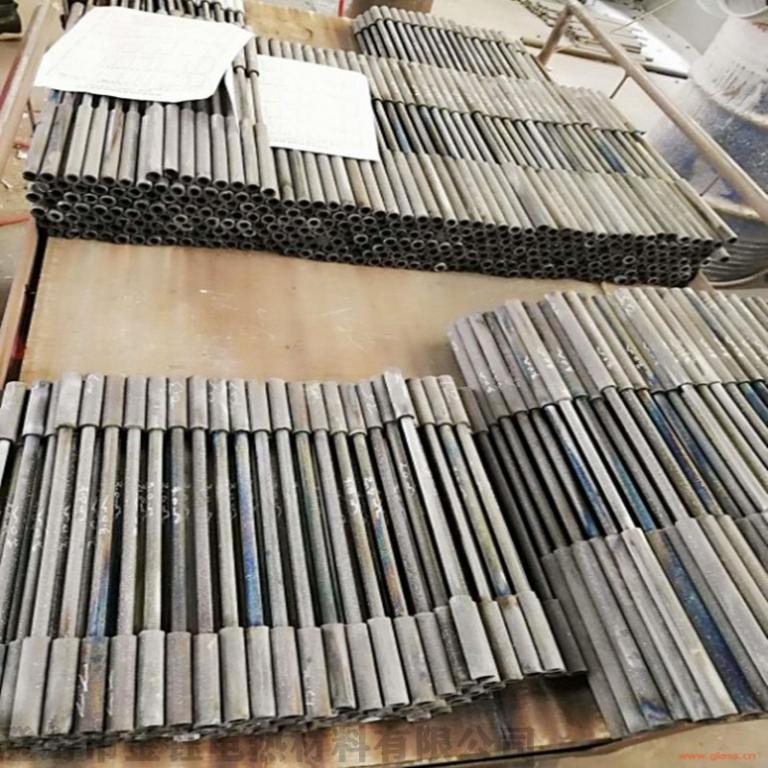
| Industry Category | Chemicals/Oxides/Other Oxides |
|---|---|
| Product Category | |
| Brand: | 金钰 |
| Spec: | 14/22*250*150 |
| Stock: | 10000 |
| Manufacturer: | 登封市金钰电热材料有限公司 |
| Origin: | 114101 |


